

Starting a car rental business in 2026 has officially evolved past a casual side hustle model. It represents a highly sophisticated corporate enterprise opportunity for forward thinking entrepreneurs who want to build a highly automated, asset backed, and structurally insulated transport logistics firm.
True enterprise profitability does not come from simply purchasing a vehicle asset and throwing it onto a third party peer to peer app block. Sustainable scaling requires building an independent operational ecosystem that aggressively protects your personal assets, actively mitigates fleet overhead, optimizes daily utilization, and shifts your client acquisition pipeline away from absolute third party marketplace reliance.
This comprehensive launch guide provides an actionable, data validated 7 step blueprint designed for new fleet operators, scaling peer to peer hosts, and independent transport companies looking to deploy professional systems from day one.
The Structural Realities of Modern Fleet Logistics
The independent vehicle mobility ecosystem has completely matured. The vehicle rental sector is currently experiencing a permanent shift in customer behavior: corporate travelers, local consumers, rideshare operators, and insurance replacement clients are systematically choosing on demand vehicle access over the steep financial commitments of traditional vehicle ownership.
While this demand loop presents a massive window of opportunity for independent operators, the search landscape and local markets are far more competitive than in previous cycles. Succeeding today requires a comprehensive, financially modeled car rental business plan, enterprise grade commercial liability insurance, dynamic pricing engines, automated digital agreements, and a centralized technology engine to run the business.
A successful enterprise mobility ecosystem requires a distinct division between your physical fleet hardware and your digital software infrastructure. The hardware layer demands economy or mid size vehicles backed by robust commercial protection policies and active telematics tracking. In contrast, the software layer governs your automated reservation engine, direct booking funnels, and biometric verification workflows.
The primary difference between a time constrained marketplace host and a highly profitable fleet executive is not the physical vehicle count. It is the underlying digital infrastructure driving the company. By choosing the right execution framework early, even a single initial vehicle can be leveraged to build a self sustaining, corporate car rental company.
The 7 Step Operational Launch Framework
1. Establish Your Corporate Entity and Legal Shield

The absolute baseline in learning how to start a car rental business is to build an impregnable legal barrier around your personal assets. You should always run a high liability transport firm under a business name. You need to methodically establish a Limited Liability Company or similar corporate entity, obtain a separate Federal Employer Identification Number (EIN), and open a corporate commercial bank account to absolutely prevent the commingling of personal and business cash.
This stage is not just about improving corporate tax pass through loops. It is about insulating your own net worth from the hazards of your systemic operations. Fleet assets are invariably vulnerable to active road dangers, civil litigation, complex insurance disputes and consumer responsibility claims. Creating a tidy company structure provides a professional base for your first rental. You also need to write your state by state master rental terms, customized geographic rules, preventive maintenance recording settings, and automated customer contact processes to maintain operational consistency.
2. Solve the Commercial Insurance Bottleneck Early
Securing compliant insurance coverage is one of the most significant operational hurdles for new fleet owners. Standard personal auto insurance policies universally contain explicit commercial exclusion clauses. If an asset is deployed for profit or hired out to a third party driver under a personal policy, your carrier will flatly deny any physical damage or third party liability claims, exposing your business to severe financial loss.
To run your operations cleanly, your comprehensive car rental business plan must account for specialized commercial fleet auto liability insurance. This specialized insurance must provide continuous coverage across both active rental periods and off rental maintenance intervals—such as when vehicles are being detailed, delivered, or stored. Before acquiring multiple vehicles, partner with specialized commercial brokers who understand independent transport logistics. Because insurance premiums represent your largest recurring fixed expense, these costs must be carefully modeled to preserve your baseline profit margins.
3. Deploy an ROI Driven Fleet Acquisition Strategy
Amateur operators often make the mistake of buying high depreciation luxury vehicles or flashy sports cars first because they look appealing online. However, an elite fleet acquisition model ignores emotional bias and focuses strictly on asset utilization rates, maintenance costs, and capital return curves.
Modern operational data demonstrates that the highest, most predictable returns are consistently generated by reliable economy sedans, mid size crossovers, and highly fuel efficient hybrid vehicles. These specific asset classes capture a significantly broader, more stable consumer demographic and carry substantially lower long term maintenance overhead compared to exotic luxury segments.
Before finalizing any vehicle acquisition, run a complete total cost of ownership (TCO) calculation. Your formulas must compound monthly principal and interest debt service payments, commercial fleet liability insurance premiums, scheduled preventive maintenance cycles (such as tires, brakes, and fluid changes), localized asset depreciation curves, and unavoidable operational downtime intervals. Your objective is simple: purchase high demand, reliable assets that yield reliable cash flow and maintain stable utilization metrics in your target market.
4. Leverage Online Marketplaces for Asset Incubation
Utilizing decentralized peer to peer marketplaces like Turo is an exceptional strategy when incubating a new Turo car rental business. These established digital channels provide immediate access to a massive stream of organic consumer demand, built in marketplace trust, standardized merchant processing, and immediate localized review validation.
These consumer platforms allow you to systematically validate your local market demand, optimize your delivery mechanics, test seasonal pricing adjustments, and establish initial operational cash flow without burning cash on expensive upfront customer acquisition funnels.
However, relying entirely on a third party aggregator must never be your ultimate business model. Marketplaces are incubation tools. If your entire reservation pipeline depends on a single application, your business remains structurally exposed to unexpected platform fee hikes, sudden algorithm adjustments, and account suspension risks. Use these platforms to fund your initial growth, while concurrently building your own independent digital infrastructure.
5. Deploy Enterprise Grade Digital Infrastructure From Day One
Elite operators do not wait until they manage a massive fleet to organize their logistical systems. They build the digital foundation before the first car ever rolls off the lot. This is exactly where integrating an advanced car rental management software hub becomes the ultimate competitive advantage for a scaling company.
A modern vehicle rental business requires automated workflows to handle digital contract signing, real time identity verification (IDV), automated calendar scheduling, centralized payment recording, and precise vehicle tracking. Managing these intensive variables manually through standard text messages and fragmented spreadsheets is an operational hazard that causes scheduling errors, unsigned rental agreements, and unrecovered physical damages.
If you want to know how to start a car rental business the right way, the secret lies in deploying the best car rental software early. Implementing a centralized dashboard ensures that your scheduling logic, contract execution, and renter tracking remain completely flawless from your very first customer transaction.
6. Systematically Migrate Toward Direct Bookings
Every time a customer completes a rental cycle with your company, your primary logistical goal must be transitioning them into your own private booking ecosystem. Launching a high conversion, direct to consumer booking portal allows repeat corporate clients, local renters, and vacationers to secure assets without routing through an intermediate marketplace aggregator.
Eliminating the middleman is vital because marketplace commissions can heavily restrict your long term profit margins. When a third party application extracts a double digit cut of your gross revenue, your scaling velocity slows down. By running your brand through advanced car rental booking software, you can offer your repeat clients preferential pricing models while retaining significantly higher net margins within your corporation. Transitioning customers to an independent booking pipeline naturally reduces platform dependency and builds genuine enterprise brand equity.
7. Maximize Asset Utilization and RevPAV via Data Analytics
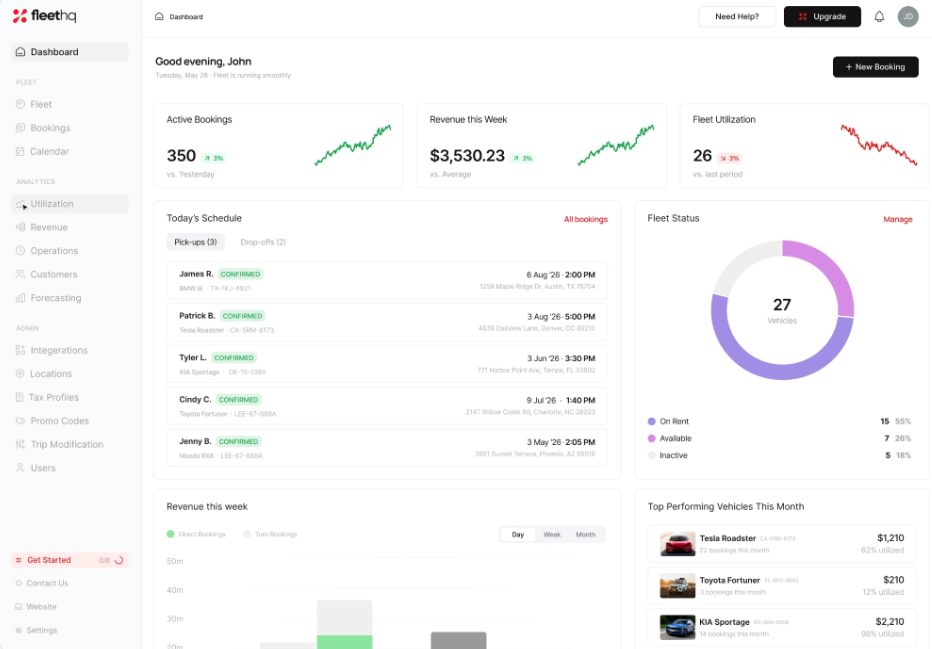
A truly successful vehicle enterprise is not evaluated by raw fleet size; it is measured by the net revenue efficiency of each active asset. Your Utilization Rate, the percentage of calendar days your vehicles are actively earning on the road, represents your most critical performance indicator.
Professional operators aim for a stabilized fleet utilization benchmark of 70% to 80%. If your vehicles maintain a 100% utilization rate over an extended period, it is a clear algorithmic indicator that your daily pricing model is underpriced. Conversely, if your assets sit idle on the lot for too long, your regional pricing tiers, geographic locations, vehicle classes, or local search marketing require strategic adjustment.
Deploying specialized software for car rental companies gives you access to real time financial reporting. This data visibility allows you to monitor exactly which vehicle categories deliver the highest net revenue per available vehicle (RevPAV), enabling you to scale your business using concrete data rather than emotional guesswork.
The Financial Reality: Step by Step Asset Scaling
One of the most powerful advantages of launching an independent transportation company in 2026 is that you can completely validate the business model with a single asset. You do not need massive institutional capital on day one. By pairing a strategic vehicle down payment with a commercial insurance line, localized digital branding, and a professional management platform, you can successfully launch with a lean, highly efficient startup budget.
The trick is treating that first vehicle as a strict corporate asset, rather than a casual side income stream. Rigorously log every micro expense, measure your seasonal utilization loops, and establish a repeatable, automated checkout workflow. Once your first asset proves its unit economics, you can confidently replicate the model to add your second, fifth, or twentieth vehicle.
Deploying a dedicated car rental software system allows you to establish a professional digital workflow before your first vehicle even hits the pavement. This ensures your business launches with institutional grade operations from day one, rather than trying to fix fragmented, manual processes later as your fleet grows. FleetHQ’s 7 day free trial can help you set up your digital rental workflow before your first vehicle even hits the road. Click here to register for our platform and Start Your Free Trial with FleetHQ to unlock professional automation for your business today.
(FAQ)
What are the baseline software requirements to successfully take a vehicle rental brand private?
To scale an independent company outside platform ecosystems, your tech stack must utilize centralized car rental computer software models. This unified platform requires three critical operational modules: a conversion optimized front end website with a live booking calendar, an integrated identity verification system to validate renter documentation, and a secure payment gateway capable of processing high value security deposit pre authorizations cleanly.
How does fleet management software protect an independent company from vehicle theft?
Advanced rental fleet management software integrates directly with specialized telematics and GPS tracking APIs. This allows fleet CEOs to monitor active location coordinates, track boundary crossings, and review vehicle diagnostics in real time. If a renter violates geographic boundaries or fails to return an asset, the software provides the precise data logs and asset location metrics required by law enforcement and insurance adjusters to recover the property.
Why is a personal auto insurance policy invalid for independent car rental operations?
Personal auto policies are underwritten exclusively for private, non commercial vehicle use. Every standard personal policy contains explicit commercial exclusion clauses that invalidate coverage the moment a vehicle is rented to a third party for profit. Operating without dedicated commercial fleet insurance exposes the owner to total financial liability for vehicle damages, property destruction, and medical claims.