Car Rental Booking Software: How to Prevent Double Bookings and Calendar Conflicts
Fleethq • 16 Jul 2026
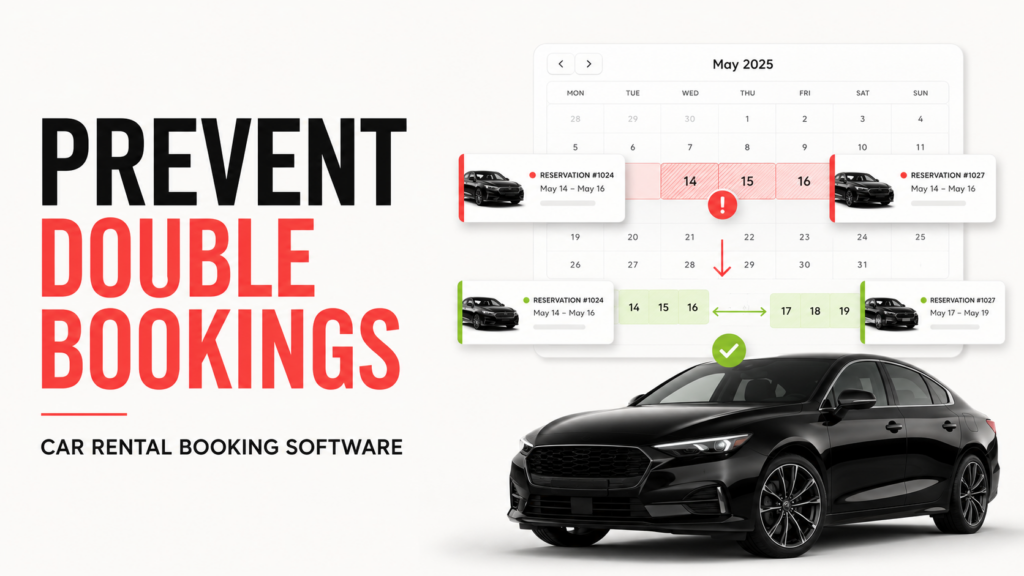
Car rental booking software prevents double bookings by tracking vehicle availability in real time and locking a car across every sales channel the instant it’s reserved. That means no spreadsheets, no manual dateblocking, and no two customers arriving for the same car.
A single double booking is expensive: a refunded deposit, a scramble for a replacement vehicle, a possible no show fee, and often a one star review. Below is why double bookings happen, what they cost, and the system changes that stop them for good.
Key Takeaways
Double bookings come from four root causes: manual calendars, availability lag, unsynced channels, and missing buffer time.
The fix is a single source of truth realtime availability that updates the moment a car is reserved.
Operators renting through both a direct site and a marketplace (like Turo) need automated crosschannel calendar sync on top of realtime availability.
Car rental reservation software turns booking accuracy from a daily manual task into an automated background process.
What Causes Double Bookings and Calendar Conflicts?
Nearly every double booking traces back to one of five failure points:
Manual calendars and spreadsheets. Every handtyped update is a chance for error, and that risk compounds as your fleet grows.
Availability lag. If one channel updates even minutes after a booking, that gap is enough for a second customer to reserve the same car.
Overlapping channels. Your direct site, marketplace listings, phone bookings, and walkins each hold their own view of availability unless one system unifies them.
No buffer time. Backtoback trips with no gap for cleaning or inspection create real conflicts even when the calendar shows a car as “available.”
Human error under pressure. During busy periods, staff miss an existing reservation or release a car before confirming its status.
A double booking is never just an inconvenience. It triggers a chain reaction: an emergency refund, the cost of sourcing or upgrading a replacement vehicle, potential no show or cancellation fees, staff time spent firefighting, and lasting reputation damage from a bad review.
For independent operators running lean teams, each of those costs lands directly on the bottom line. That’s why prevention is not damage control. It has to be the goal.
How to Prevent Double Bookings: A 6Step Framework
Move off spreadsheets. Replace manual calendars with car rental booking software that holds a single source of truth for availability.
Enable realtime availability. A booking should instantly remove that vehicle from the available pool everywhere it’s listed.
Unify every channel. Bring your website, marketplace listings, and phone bookings into one calendar so they can’t conflict.
Add buffer times. Build turnaround gaps between trips so back to back rentals never overlap.
Automate confirmations and reminders. Cut noshows and lastminute chaos with automatic notifications.
Review utilization data. Use booking reports to spot patterns and plan staffing and fleet size around peak demand.
RealTime Availability vs. Manual Calendars
Factor
Manual Calendar
RealTime Availability
Update speed
Delayed, error prone
Instant
Doublebooking risk
High
Minimal
Scales with fleet size
Poorly
Easily
Staff workload
Heavy
Light
Customer experience
Inconsistent
Reliable
Coordinating Bookings Across Channels
If you rent through your own website and a marketplace like Turo, realtime availability alone isn’t enough. The channels also need to be linked, so a booking on one instantly blocks the vehicle on the other. This crosschannel coordination deserves its own deep dive; see our full guide toCoordinating direct and marketplace bookings for the complete playbook.
How FleetHQ Prevents Double Bookings
FleetHQgives operators real time availability across their whole fleet, plus Turo Calendar Sync so marketplace and direct bookings share one calendar. Reservations, payments, agreements, and verification all live in one platform, so booking accuracy is enforced automatically on every rental instead of depending on staff memory. Operators consistently cite the end of manual dateblocking as one of the biggest wins after switching.
Double bookings aren’t bad luck — they’re the predictable result of manual calendars and disconnected channels. Car rental booking software with realtime availability and automated sync removes those failure points, protecting your revenue, your reputation, and your customers’ trust.
Answers to the most important questions related to this post.
How do I stop double bookings in my car rental business?+
Use car rental booking software with realtime availability, so a reservation instantly blocks that vehicle on every channel. Add buffer times between trips and sync any marketplace listings to the same calendar.
What causes double bookings in car rentals?+
The main causes are manual calendars, delays in updating availability, overlapping booking channels, and a lack of buffer time between trips.
Can car rental booking software sync with Turo and other marketplaces?+
Yes. Platforms with calendar sync automatically block a vehicle across your direct site and connected marketplaces whenever it's booked on any of them.
What is realtime availability, and why does it matter?+
Realtime availability means the system updates the instant a booking is made, removing that vehicle from the available pool everywhere at once. It's the core defense against double bookings.
How do I manage bookings across multiple channels?+
Bring every channel into one platform with automated sync, so all bookings draw from a single, always current view of availability.
Subscribe to FleetHQ Blog
Fleet management tips, growth strategies, and industry insights — straight to your inbox.